

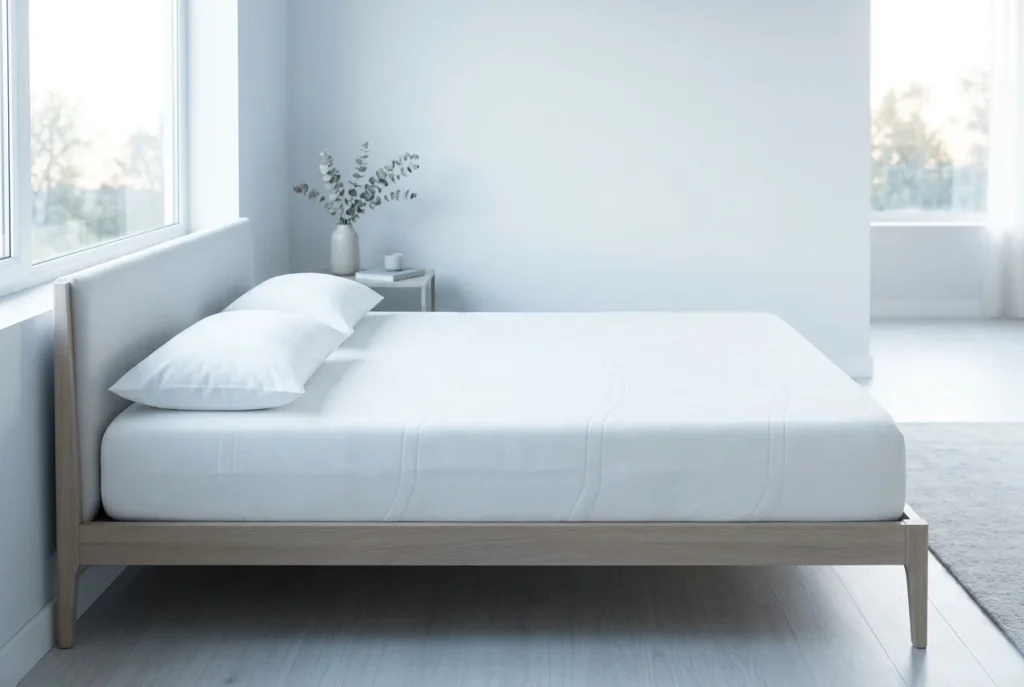
A mattress is not a one-year purchase. It’s an investment for eight to ten years, and during that time you’ll spend about a third of your life on it. The wrong mattress leads to back pain, poor sleep, and chronic exhaustion. The right mattress supports your spine, relieves pressure points, and helps you fall asleep faster and sleep deeper. But the market is confusing, and manufacturers’ claims are often misleading. Here are the 7 criteria that really matter.
Firmness: Harder is not better
The most common misconception: a firm mattress is good for your back. That’s not universally true. Firmness must match your body weight and preferred sleep position. Light people under 60 kilos need a softer mattress (firmness level 2 or H2) so that shoulders and pelvis can sink in and the spine stays straight. Average weight between 60 and 80 kilos does well with H3. Heavy people over 80 kilos need H4 so the mattress doesn’t sag. If you sleep on a mattress that’s too firm, your shoulders and hips can’t sink in. If you sleep on one that’s too soft, you sag through and your spine droops. A study by Radwan and colleagues (2015) found that medium-firm mattresses significantly improved sleep quality and pain in people with chronic back pain compared to firm mattresses. The old rule “the firmer the better” has been scientifically disproven.
Material: Cold foam, spring core, or latex?
Three materials dominate the market, and each has pros and cons. Cold foam is the best-selling material in Germany. It’s affordable, durable, and adaptable, but it traps body heat and can cause sweating in summer. Spring core, whether open-cell or pocket spring, has the best ventilation and is ideal for people who sweat at night. But it’s heavier and more expensive. Latex is the eco-material: natural, durable, well-ventilated, and point-elastic. But it’s also the most expensive material and hard to flip. A study by Leilnahari and colleagues (2018) found no significant differences in sleep quality between materials, as long as firmness and body contour adaptation were correct. Material is secondary, as long as firmness and zoning are right.
Zoning: Why a mattress needs zones
The human body is not flat, and a good mattress accounts for that. Zones are areas of different firmness within a mattress. A 7-zone mattress has softer zones for the shoulder and pelvis and firmer zones for the lumbar area. This is important because shoulders and pelvis need to sink in, while the lumbar area needs support. Without zoning, the spine lies on an entirely soft or entirely hard surface, both of which are wrong. The shoulder zone needs more give than the lumbar zone. And the pelvic zone needs to sink wider than the shoulder zone because the pelvis is heavier. Side sleepers need a particularly pronounced shoulder zone so the shoulder can sink in and the spine stays straight.
Cover fabric and hygiene
The cover fabric is more important than many think. You sweat about 0.5 liters of fluid per night, and the mattress must absorb and release this moisture. A good cover is breathable, moisture-regulating, and washable at 60 degrees. Look for the OEKO-TEX Standard 100 certification, which excludes harmful substances. Allergy sufferers should choose a cover washable at 60 degrees to remove dust mites. Some manufacturers offer double-cloth covers that can be flipped, doubling the lifespan. And: a removable cover is more hygienic than a sewn one because it can be washed regularly.
Trial sleep: Why 30 days minimum are necessary
Lying on a mattress in a store for 10 minutes is not enough. The body needs at least two weeks to adjust to a new mattress. In the first few days, every new mattress feels different, and muscle groups that were previously tense need time to relax. When buying, look for a trial period of at least 30 days, preferably 60 or 100 days. Some online retailers even offer 100 days. If the mattress still doesn’t fit after 30 days, exchange it. And during the trial phase, always sleep on the new mattress, not alternating with the old one. The body needs to adjust completely.
When it’s time for a new mattress
A mattress’s lifespan depends on the material and care. Cold foam lasts about 7 to 10 years, spring core about 8 to 10 years, latex about 10 to 12 years. Signs of a worn-out mattress: a visible sag in the middle, morning back pain that disappears after 30 minutes, a sagging feeling, or sleeping better when you stay somewhere else. A study by Enomoto and colleagues (2019) found that sleep quality on mattresses older than 7 years was significantly worse than on new mattresses, regardless of material. Flipping and airing your mattress regularly extends its life, but sooner or later every mattress needs replacing.
Price: What a good mattress costs
Good mattresses cost between 300 and 800 euros. Anything below is often inferior, anything above is usually premium marketing. Price alone is not a quality indicator. Firmness, zoning, material, and cover fabric are more important than price. If you have back pain, invest in a higher-quality mattress, because saving on the mattress often doesn’t offset the extra costs at orthopedists and physical therapists. Calculation: over a 10-year lifespan, a 600-euro mattress costs 16 cents per night. A bad night costs more.
Conclusion: The mattress is the foundation of sleep
The mattress is the most important piece of furniture in the bedroom. Not the wardrobe, not the bed frame, the mattress. It determines whether your spine is supported or sags at night, whether your muscles relax or tense up, whether you wake up refreshed or in pain. Firmness, zoning, and cover fabric are more important than material. Trial sleeping is mandatory, at least 30 days. And a mattress older than 7 years should be checked and replaced if necessary. Following these 7 criteria will help you find the right mattress. No magic, no marketing promises, just facts.
Beste Grüße, Monika
Haupt-Keyword: mattress sleep
Sekundäre Keywords: mattress firmness, cold foam spring core latex, mattress back pain, replace mattress, 7 zone mattress