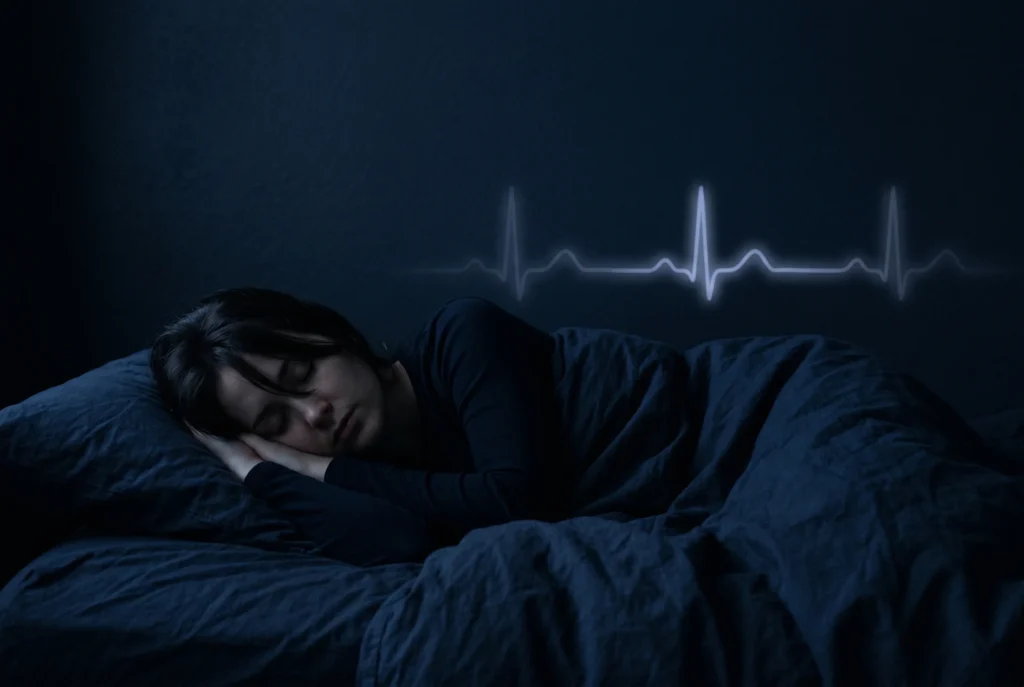

Street noise, a snoring partner, paper-thin walls: noise is one of the most common reasons for poor sleep. And it’s sneaky. You don’t have to wake up to be affected. Even quiet sounds below 40 decibels that don’t wake you can alter sleep architecture and reduce deep sleep. A study by Muzet (2007) found that chronic nighttime noise significantly reduced deep sleep and REM sleep proportions, even in people who reported not waking up from the noise. Here’s the explanation and what you can do.
How noise affects sleep, even without waking up
Sleep is not a one-way street but a cycle of light, deep, and REM phases. Noise disrupts this cycle, even if you don’t notice it. A sound of 33 decibels, quieter than a whisper, can already increase heart rate and trigger a shift from deep sleep to light sleep. Above 40 decibels, about the level of light traffic, wake-up probability and cortisol secretion increase. Above 55 decibels, normal street traffic, the risk of cardiovascular disease demonstrably rises. The World Health Organization recommends a nighttime noise level below 30 decibels for healthy sleep. In German cities, the average is 45 to 55 decibels.
Street noise: The most common disruptor
Street noise is the best-studied nighttime noise factor. A meta-analysis by Basner and colleagues (2014) found a linear relationship between nighttime noise level and sleep quality. Every decibel above 40 reduces total sleep duration and increases wake-up frequency. People living on main roads have 30 to 50 percent higher morning cortisol levels than people in quiet neighborhoods. The most effective measure against street noise is double windows or soundproof windows, which can reduce noise by 25 to 40 decibels. If renovation isn’t an option, acoustic curtains and window frame seals can reduce noise by 5 to 10 decibels.
Snoring: When your partner becomes a noise problem
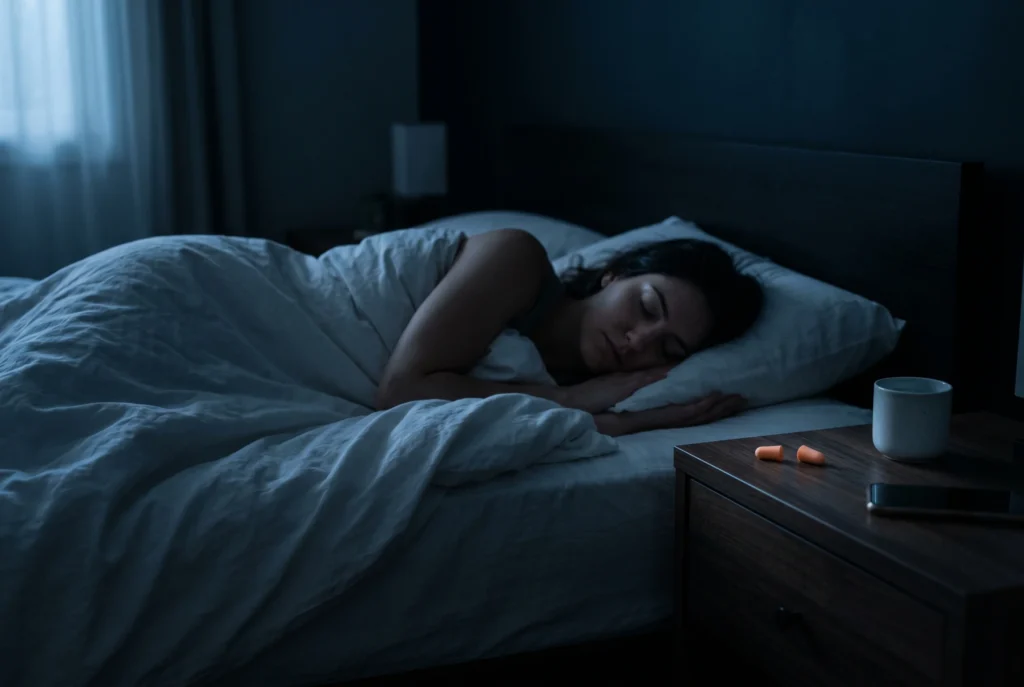
About 25 percent of adults snore regularly, and the noise level can reach 50 to 90 decibels. That’s comparable to a vacuum cleaner or a passing truck. The consequence for the bed partner: chronic sleep deprivation that isn’t compensated for by habituation. A study by Beninati and colleagues (2015) found that partners of snorers lost an average of 1 to 2 hours of sleep per night. Solutions range from earplugs to anti-snoring devices for the partner to separate bedrooms. Wax or silicone earplugs reduce noise by 20 to 35 decibels and are the simplest measure. If you don’t want to wake your partner, white noise machines can mask the snoring sound.
White noise: Helper or disruptor?
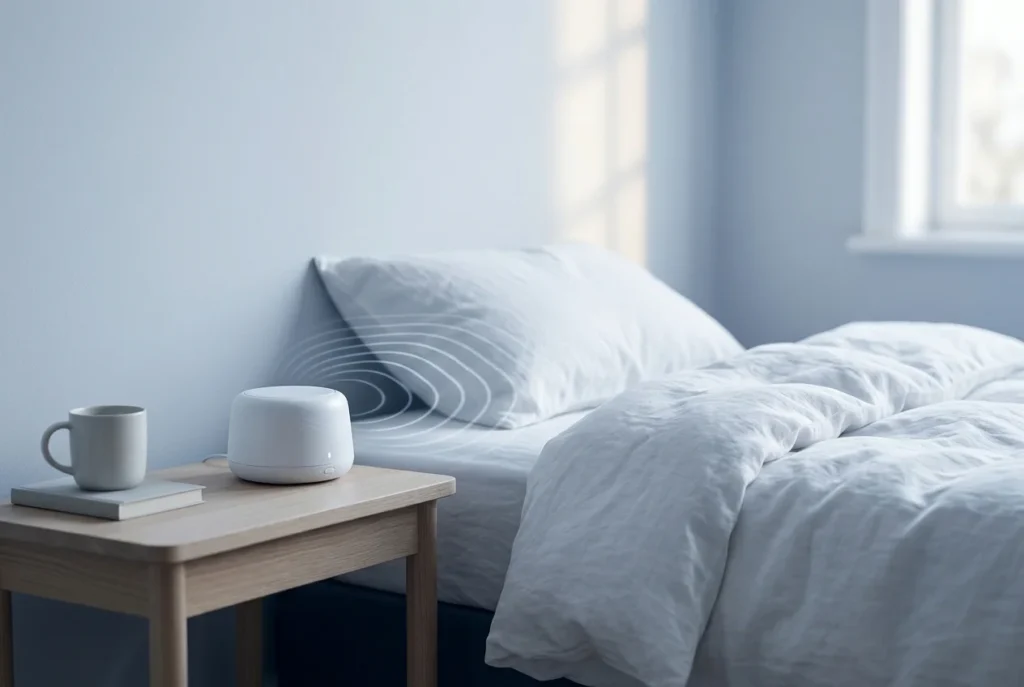
White noise, a consistent rushing sound across all frequencies, is increasingly popular as a sleep aid. The idea: a steady background sound masks disruptive noises through sound masking. A study by Zhou and colleagues (2022) found that white noise reduced sleep onset latency in noisy environments by an average of 38 percent. However, there are also risks. White noise at too high a volume, above 50 decibels, can become a noise problem itself. And becoming dependent on the sound can make it impossible to fall asleep without it. The recommendation: use white noise at 40 to 45 decibels, no louder than a quiet library, and only for falling asleep, not all night.
Earplugs: The simplest solution
Earplugs are the simplest, cheapest, and most underrated measure against nighttime noise. Wax, silicone, or foam earplugs reduce noise by 20 to 35 decibels, depending on material and fit. Wax and silicone mold to the ear canal and are especially effective; foam is cheaper and easier to handle. Important: earplugs must be inserted correctly. They need to completely seal the ear canal. A common mistake is placing them loosely in the outer ear. They must be inserted into the ear canal and pressed until they expand. When properly fitted, they dramatically reduce noise levels without disturbing sleep.
Room acoustics: What you can change in the bedroom
Besides external noise, bedroom acoustics matter too. Hard surfaces like wood, tile, and glass reflect sound and amplify it. Soft surfaces like carpets, curtains, and upholstery absorb sound and dampen it. To improve bedroom acoustics, use a thick carpet or rug, hang heavy curtains on windows, place bookshelves on walls as sound absorbers, and install upholstered furniture or acoustic panels. These measures can reduce room reverberation by 3 to 6 decibels. Not enormous, but effective in combination with earplugs or white noise.
Conclusion: Noise is not fate
Nighttime noise is one of the most underestimated sleep killers. It alters sleep architecture, raises cortisol levels, and reduces deep sleep, even without waking you up. The most effective measures are earplugs (20 to 35 decibel reduction), soundproof windows (25 to 40 decibels), white noise for falling asleep, and acoustic improvements in the bedroom. Taking your sleep environment seriously starts with the simplest measures: earplugs and a white noise machine. They cost little and work immediately.
Beste Grüße, Monika
Haupt-Keyword: sleep sounds block noise
Sekundäre Keywords: noise sleep, white noise sleep, earplugs snoring, street noise sleep quality, bedroom acoustics