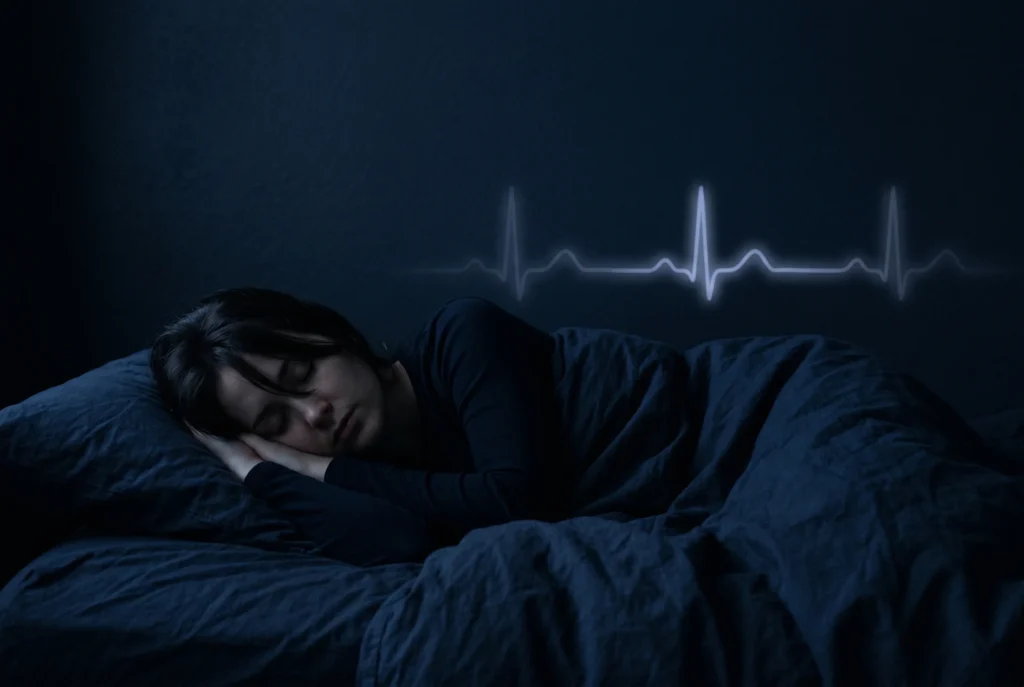


It’s quiet in the room, you’re lying in bed, and suddenly you feel it: pounding in your chest, heart palpitations, maybe even a racing heart. Your heart beats faster than it should, and in the silence of the night, every beat feels like a drummer who won’t stop. Heart palpitations at night are one of the most common causes of sleep disorders, and in most cases they’re harmless. But they don’t feel harmless. Here’s the explanation and what you can do.
What causes heart palpitations at night
Heart palpitations at night have several causes, most of them harmless. The most common cause is increased sympathetic nervous system activity: the fight-or-flight part of the nervous system is still active in the evening, even though the body should be resting. This can be caused by stress, caffeine, alcohol, or intense exercise in the evening. A study by Lessmeier and colleagues (2006) found that in 84 percent of cases with nocturnal palpitations, there was no cardiac cause, but rather a combination of stress, caffeine, and anxiety. Other common causes: hormonal fluctuations, especially during menopause, hyperthyroidism, medication side effects, and sleep apnea.
Harmless or dangerous: When to see a doctor
Most nocturnal heart palpitations are harmless, but some symptoms require medical evaluation. Harmless palpitations occur occasionally, last a few minutes, and resolve on their own without other symptoms. Potentially dangerous palpitations are accompanied by chest pain, shortness of breath, dizziness, fainting, or feelings of anxiety. A study by Weber and colleagues (2018) found that about 16 percent of patients with nocturnal palpitations had a relevant cardiac arrhythmia that needed treatment. Anyone experiencing severe nocturnal palpitations for the first time should have them medically evaluated, if only for reassurance. An ECG, a Holter monitor, and blood work can rule out the most common causes.
Stress and anxiety as main drivers
Stress and anxiety are the most common causes of nocturnal palpitations, and they reinforce each other. Palpitations create anxiety, and anxiety intensifies the palpitations. A study by May and colleagues (2018) found that 68 percent of patients with nocturnal palpitations had an anxiety disorder or elevated anxiety sensitivity. The mechanism: anxiety activates the sympathetic nervous system, which increases heart rate and blood pressure. In the silence of the night, without distraction, the palpitations are much more noticeable than during the day. This leads to anxiety-laden attention to the heart, which further intensifies the palpitations. The vicious cycle of palpitations, anxiety, and sleeplessness is one of the most common causes of chronic insomnia.
Lifestyle factors that amplify palpitations
Beyond stress, several lifestyle factors can amplify nocturnal palpitations. Caffeine is the most common trigger: a study by Temple and colleagues (2019) found that caffeine consumption after 2 PM increased the likelihood of nocturnal palpitations by 40 percent. Alcohol is the second most common trigger: alcohol helps with falling asleep but causes a rebound effect in the second half of the night with increased sympathetic activity and heart rate. Intense exercise within 3 hours of bedtime can elevate your pulse and make falling asleep harder. Heavy meals in the evening increase heart rate because the body has to manage digestion. And finally: sleep deprivation itself amplifies palpitations by increasing sympathetic activity.
What you can do: Immediate measures and prevention
When palpitations occur at night, there are immediate measures that can help. First: the 4-7-8 breathing technique: inhale for 4 seconds, hold for 7 seconds, exhale for 8 seconds. This technique activates the parasympathetic nervous system and lowers heart rate within minutes. Second: cold water on your face or wrists. The cold stimulus activates the dive reflex, which lowers heart rate. Third: lie on your side, preferably the left side, because palpitations are often felt less strongly there. For prevention: no caffeine after 2 PM, no alcohol in the evening, no intense exercise within 3 hours of bedtime, and stress management through relaxation techniques like progressive muscle relaxation or meditation.
When palpitations indicate sleep apnea
Nocturnal palpitations can also be a symptom of sleep apnea. In sleep apnea, repeated breathing pauses lower blood oxygen levels and activate the sympathetic nervous system. The heart responds with tachycardia, an accelerated heartbeat, often accompanied by awakening. A study by Gami and colleagues (2005) found that patients with obstructive sleep apnea had a significantly increased risk of nocturnal cardiac arrhythmias. Signs of sleep apnea as a cause: loud snoring, breathing pauses observed by a partner, morning fatigue despite seemingly adequate sleep, and morning headaches. Anyone with these symptoms should undergo sleep apnea screening.
Conclusion: Usually harmless, but take it seriously
Nocturnal heart palpitations are harmless in most cases, but they don’t feel harmless. The most common causes are stress, anxiety, caffeine, and alcohol. The vicious cycle of palpitations, anxiety, and sleeplessness can be broken if you know the causes and apply immediate measures. Anyone experiencing severe nocturnal palpitations for the first time should have them medically evaluated. And anyone with signs of sleep apnea should get screened. In most cases, adjusting lifestyle and reducing stress is sufficient. The heart doesn’t pound at night to scare you but because it’s receiving signals it doesn’t need.
Beste Grüße, Kai
Haupt-Keyword: heart palpitations at night
Sekundäre Keywords: heart racing at night sleep, palpitations anxiety, racing heart falling asleep, heart pounding at night stress, nocturnal palpitations