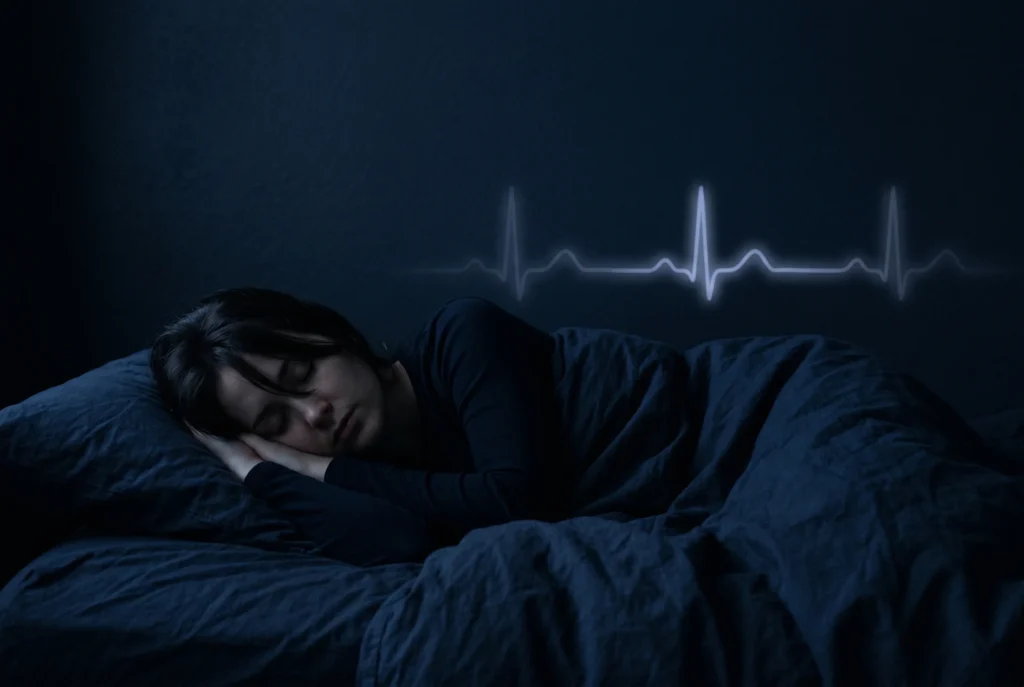

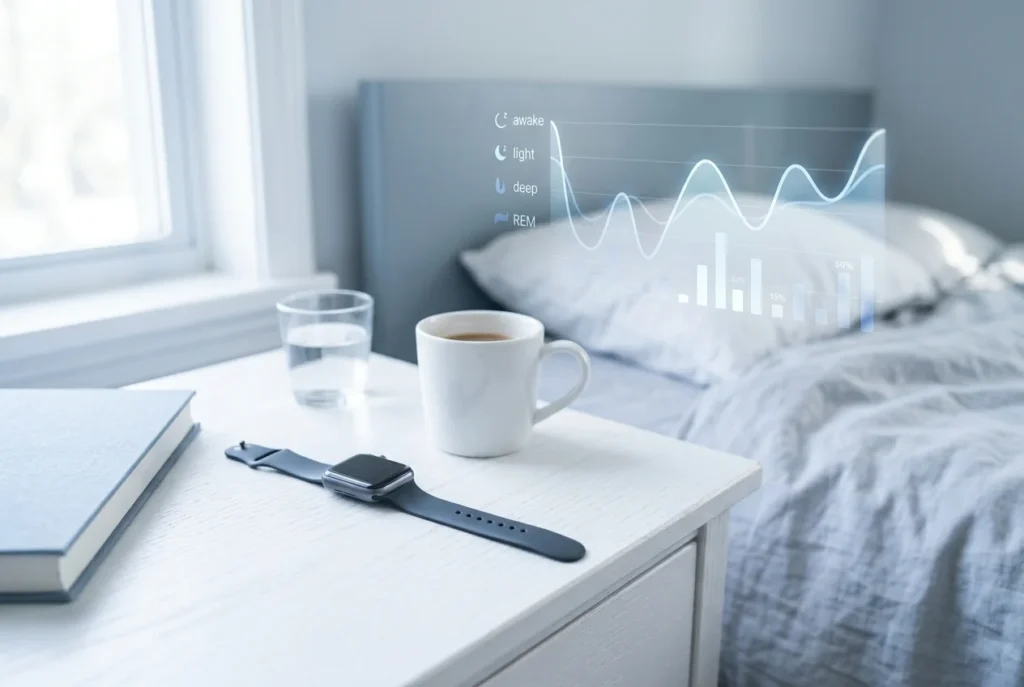
Sleep trackers promise insight: How deep do I sleep? When am I in REM? How restorative is my night? The app on the watch, the band on the wrist, the mat under the mattress: the market for sleep tracking has exploded, driven by the sleepmaxxing trend. But the question is: do these devices really measure what they claim? The short answer: sort of. The longer answer follows.
What sleep trackers measure and what they don’t
Most sleep trackers, whether on the wrist or finger, measure acceleration (movement), heart rate, and sometimes heart rate variability (HRV) and oxygen saturation. From this, they calculate a sleep stage assignment: awake, light sleep, deep sleep, REM. The problem: none of these devices measure brain activity, the gold standard in sleep research. Brain activity, measured with electroencephalography (EEG), is the only reliable method for determining sleep stages. Movement and heart rate are proxy measures that allow approximate assignment but don’t reach the precision of EEG. A study by de Zambotti and colleagues (2019) found that commercial wearables determined sleep stages with only 50 to 70 percent accuracy compared to the polysomnographic gold standard. For deep sleep and REM, accuracy was even lower.
Apple Watch, Oura Ring, Whoop and Co.: The major players
The Oura Ring is considered one of the most accurate consumer sleep trackers. It measures heart rate, HRV, body temperature, and movement and provides a so-called readiness score for the next day. A validation study by de Zambotti and colleagues (2017) found that the Oura Ring determined total sleep duration with an deviation of about 10 minutes but was significantly worse at sleep stages than in the lab. The Apple Watch has offered sleep tracking with stages since WatchOS 9, based on acceleration and heart rate. Accuracy is comparable to other wearables, but battery life is a problem: if you track at night, you need to charge the watch during the day. Whoop and Garmin offer similar features with different focuses. The truth: none of these devices reaches the accuracy of a PSG. But they are useful for trends.
The trend is more important than the absolute value
The most important insight of recent years: sleep trackers are good at detecting trends but bad at delivering absolute values. If your tracker shows you averaged 30 minutes less deep sleep this week than last week, that’s probably correct. If it shows you had exactly 1 hour and 47 minutes of deep sleep, take that number with a large grain of salt. A study by Chinoy and colleagues (2021) found that inter-device variability for wearables was up to 30 percent. This means: two different trackers on the same wrist can deliver results that differ by 30 percent. Use the tracker for trends, not for diagnoses.
The psychological trap: Orthosomnia
Sleep trackers have an undesirable side effect called orthosomnia in the medical literature: an excessive preoccupation with sleep data that paradoxically worsens sleep. People who check their sleep data every morning and get upset about poor values sleep worse than people who ignore the data. A study by Giese and colleagues (2022) found that people with high sleep tracking use had significantly higher scores on the Insomnia Severity Index than people who didn’t track. The explanation: when the tracker tells you your sleep was poor, you believe it and feel bad, even if you subjectively felt rested. The recommendation: use the tracker for 1 to 2 weeks to identify patterns, then put it aside for 1 to 2 weeks.
Under the mattress: Contactless trackers
A new category of sleep trackers doesn’t measure on the body but under the mattress. Devices like Withings Sleep or Earlysense measure heart rate, breathing rate, and movement through pressure sensors in a mat. The advantage: you don’t feel the device, don’t need to charge it, and can’t forget it. Accuracy is comparable to wearables for total sleep duration but worse for sleep stages because the sensors have fewer data points than a wearable on the body. For people who don’t like wearables at night, contactless trackers are a good alternative.
When a sleep tracker makes sense
A sleep tracker makes sense when you want to identify patterns: How does alcohol affect your sleep? How does your body react to late exercise? Does an earlier bedtime improve your recovery? You can answer these questions with a tracker over 1 to 2 weeks by changing variables and observing trends. A sleep tracker doesn’t make sense if you use it as a diagnostic instrument or let bad values stress you out. If you suspect you have a sleep disorder, see a sleep specialist. A wearable cannot replace a polysomnographic examination in a sleep lab.
Conclusion: Track yes, but in moderation
Sleep trackers are useful tools for self-insight, but they are not medical instruments. They measure movement and heart rate, not brain activity. Sleep stage accuracy is 50 to 70 percent. The trend is more important than the absolute value. And the psychological trap of orthosomnia can worsen sleep rather than improve it. Use the tracker for 1 to 2 weeks to identify patterns, then set it aside. If you suspect a sleep disorder, go to the doctor, not the tracker.
Beste Grüße, Kai
Haupt-Keyword: sleep tracker test
Sekundäre Keywords: Oura Ring sleep, Apple Watch sleep tracking, sleepmaxxing, sleep tracker accuracy, orthosomnia