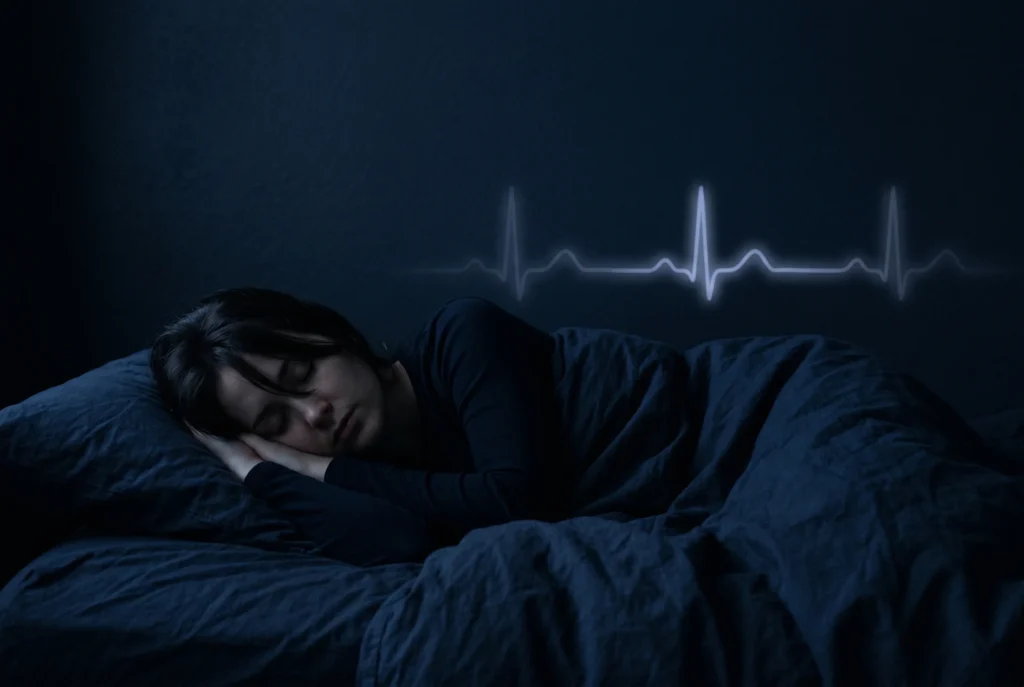

Stress is the enemy of sleep, and sleep deprivation creates stress. This is a vicious cycle that reinforces itself and keeps spinning if you don’t actively break it. When you’re stressed, you can’t fall asleep. When you don’t sleep, you become more stress-sensitive. The end result is exhaustion, irritability, and a body that no longer functions properly. The good news: the vicious cycle can be broken once you understand how it works.
How stress blocks sleep
Stress activates the sympathetic nervous system, the so-called fight-or-flight mode. The body releases cortisol and adrenaline, increases heart rate and blood pressure, tenses muscles, and makes the mind alert. This makes sense when a tiger is outside the cave, but not when you’re lying in bed and the tiger is a presentation for tomorrow. The problem: the brain cannot distinguish between real life danger and modern everyday stress. A study by Vgontzas and colleagues (2001) found that people with chronic stress took an average of 40 minutes longer to fall asleep and had 28 minutes less deep sleep than stress-free controls. Cortisol levels were elevated even at night, disrupting the natural sleep-wake rhythm.
The vicious cycle: Sleep deprivation creates more stress
The vicious cycle starts harmlessly: a stressful day leads to a bad night. But after just one sleepless night, the stress response changes. A study by Minkel and colleagues (2012) found that a single night of sleep deprivation increased the emotional response to negative stimuli by 60 percent and decreased the ability to process positive stimuli by 40 percent. This means: after a bad night, everything feels more stressful, and the next day becomes even more stressful, making the next night even worse. After three to five days in this cycle, the body is in chronic stress, and sleep has become nearly impossible, even though the original stressor may no longer exist.
Cortisol: The sleep killer
Cortisol is the central hormone in the stress-sleep dynamic. Normally, cortisol levels drop in the evening and reach their lowest point around midnight, while melatonin levels rise. With chronic stress, cortisol levels remain elevated, even at night. A study by Vgontzas and colleagues (2001) found that people with insomnia had an average 30 percent higher nighttime cortisol level than good sleepers. Elevated cortisol blocks not only falling asleep but also deep sleep, which is crucial for the body’s recovery. The result: you sleep, but you don’t recover.
Exercise as a stress buffer
Physical activity is one of the most effective stress buffers because it directly affects stress hormones. Exercise lowers cortisol levels and increases the production of endorphins and serotonin. A study by Kredlow and colleagues (2015) found that moderate aerobic exercise shortened sleep onset by 12 minutes and increased deep sleep proportion by 18 percent. Timing matters: exercise in the early afternoon improves sleep best because body temperature rises afterward and then falls, supporting the circadian rhythm. Late evening exercise can raise cortisol levels in some people and make falling asleep harder. The recommendation: 30 to 45 minutes of moderate exercise on at least 4 days per week, ideally in the early afternoon. Even a short walk after dinner is better than nothing.
Coping strategies: What really helps
The most effective strategies against the stress-sleep vicious cycle are based on three pillars: relaxation, cognitive restructuring, and sleep restriction. First: relaxation techniques like progressive muscle relaxation, autogenic training, or breathing exercises lower cortisol levels directly. A meta-analysis by Ong and colleagues (2014) found that relaxation techniques shortened sleep onset by an average of 20 minutes. Second: cognitive restructuring addresses the thoughts that maintain stress. The fear of not being able to sleep is often stronger than the original stressor. Learning to recognize and question these thoughts breaks the vicious cycle at the cognitive level. Third: sleep restriction, meaning limiting time in bed to actual sleep time, increases sleep drive and makes falling asleep easier.
The 30-minute rule and other practices
One of the simplest strategies is the 30-minute rule: if you haven’t fallen asleep after 30 minutes, get up and do a quiet activity until drowsiness sets in. Don’t lie in bed ruminating. Other practices: maintain a consistent wake time, even on weekends, to stabilize the circadian rhythm. No caffeine after 2 PM. No alcohol as a sleep aid, as it suppresses deep sleep. Establish a bedtime ritual that signals to your body that the day is over. And perhaps most importantly: write down worries and to-dos before going to bed. A study by Scullin and colleagues (2018) found that writing down to-dos shortened sleep onset by an average of 9 minutes, while writing about completed tasks had no effect.
When professional help is needed
The stress-sleep vicious cycle can be broken in most cases by consistently applying the strategies. But if sleep disorders persist for more than 4 weeks, if performance drops during the day, or if irritability and mood swings dominate daily life, professional help is indicated. Cognitive behavioral therapy for insomnia (CBT-I) is the most effective treatment for stress-related sleep disorders and has fewer side effects than sleeping pills. A referral to a sleep specialist is appropriate if sleep apnea or other organic causes are suspected.
Conclusion: The vicious cycle is breakable
Stress and sleep are mutually reinforcing, but the vicious cycle is breakable. The three pillars: relaxation, cognitive restructuring, and sleep restriction. The simplest strategies: the 30-minute rule, a consistent wake time, no ruminating in bed. The most important: write down worries before going to bed. Once you’ve broken the vicious cycle, you can recognize and stop it faster the next time. Stress is unavoidable, but sleeplessness due to stress is preventable.
Beste Grüße, Kai
Haupt-Keyword: sleep and stress
Sekundäre Keywords: stress sleep disorders, cortisol sleep, stress falling asleep, sleep anxiety stress, sleep stress cycle