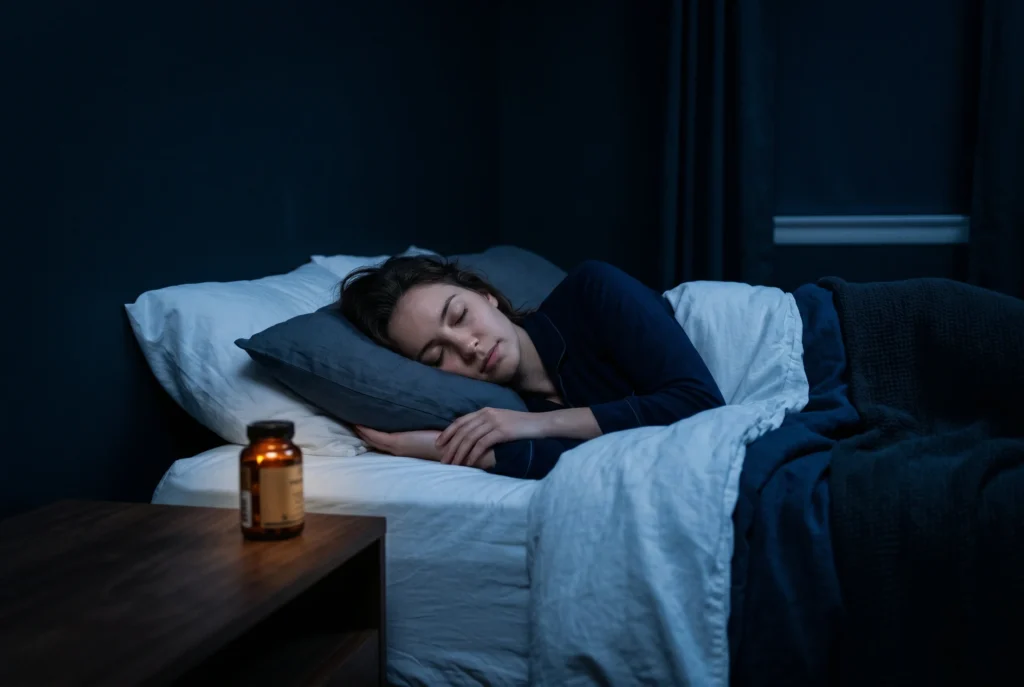


You lie in bed, mind full of thoughts, and sleep won’t come. Counting sheep doesn’t help. You’ve put the phone away, but your brain keeps racing. This is exactly where meditation comes in. Not as an esoteric ritual, but as a tool that calms your nervous system and clears the path to sleep. Science shows that meditation shortens sleep onset time and improves sleep quality. Here are the seven best guided exercises and how to try them tonight.
What does meditation do for sleep?
Meditation reduces sympathetic nervous system activation, the very system that runs on overdrive during stress and rumination. At the same time, it activates the parasympathetic nervous system, the body’s resting state. Cortisol levels drop, heart rate slows, and muscle tension decreases. A 2019 meta-analysis by Rusch and colleagues, evaluating 18 randomized controlled trials, found significant improvements in sleep quality through mindfulness meditation. The effect was especially pronounced in people with sleep disorders. This is no placebo effect. These are measurable physiological changes that put the body in a state where sleep becomes naturally possible.
The 7 best guided exercises
1. Body scan meditation
The body scan is the classic among sleep meditations. You lie down and systematically move your attention through your body, from toes to head. Each body part is noticed, not judged. Feel your toes. Feel your feet. Feel your calves. Feel your ankles. All the way to the crown of your head. The exercise typically takes 15 to 20 minutes and is especially effective when physical restlessness keeps you awake. It shifts attention away from your thoughts and into your body, breaking the rumination cycle.
2. 4-7-8 breathing
The 4-7-8 method developed by Andrew Weil is one of the simplest breathing techniques for sleep. Inhale for four seconds through your nose. Hold your breath for seven seconds. Exhale for eight seconds through your mouth. Four cycles to start, gradually increasing to eight. The extended exhale activates the vagus nerve and measurably lowers heart rate. This technique works particularly well when you feel agitated or your heart is racing. It can be done lying down without any app or audio guide.
3. Progressive muscle relaxation
Closely related to the body scan but more active: you tense each muscle group for five seconds, then consciously release. Clench your fists, hold, release. Tense your arms, hold, release. Shrug your shoulders, hold, release. All the way to your face. The contrast between tension and relaxation tires the body and reduces physical stress. Studies show progressive muscle relaxation can shorten sleep onset time by an average of 20 minutes.
4. Guided visualization
Picture a calm place. A beach. A forest. A mountain lake. Build the image in as much detail as possible: what do you hear? What do you smell? How does the ground feel beneath your feet? Visualization occupies the brain with a pleasant, calming image and pushes away the day’s worries. It’s especially effective for people who think visually and can imagine images easily.
5. Mindfulness meditation
Mindfulness doesn’t mean stopping your thoughts. It means noticing them without getting entangled. You lie there, observe your breath, and when a thought comes, you acknowledge it and return to your breath. No fighting, no suppressing. Just observing. This technique has the broadest evidence base. The aforementioned meta-analysis by Rusch et al. (2019) found that mindfulness meditation moderately improves sleep quality, especially in people with chronic sleep problems. The exercise takes 10 to 20 minutes and works with any guided audio.
6. Yoga nidra
Yoga nidra, also called “yogic sleep,” is a guided deep relaxation that keeps you at the threshold between waking and sleeping. You lie comfortably on your back and follow an instruction that guides you through body awareness, breath observation, and visualization. A study by Datta and colleagues (2017) found that yoga nidra significantly improved sleep quality. The beauty of it: you don’t need any skill. Just lie down, listen, and let it happen. 20 to 30 minutes, and many people fall asleep before it’s over.
7. Autogenic training
Autogenic training works with self-suggestions. You repeat phrases like “My right arm is very heavy” or “My breath flows calmly.” The body responds to these formulas with genuine relaxation, a feeling of heaviness, and warmth. It’s the most technical of the seven exercises and requires some practice, but once you’ve learned it, you can do it without any audio, entirely in your head. Particularly effective if you like a structured, methodical approach.
Which format works best?
Guided meditations are available as audio, video, and in apps. For sleep, audio guides are best because you don’t need a screen. Popular apps like Calm, Headspace, and Insight Timer offer dedicated sleep meditations. On Spotify and YouTube, you’ll find free guided meditations, just search for “body scan sleep” or “sleep meditation.” Important: use a timer so the audio doesn’t play indefinitely, and set your screen to night mode before putting the phone away.
When meditation isn’t enough
Meditation is a tool, not a miracle cure. For severe chronic insomnia lasting more than three months, meditation alone often isn’t enough. CBT-I is the first-line treatment here, and meditation can serve as a complement. Meditation should also be therapeutically guided for psychiatric conditions like major depression or PTSD. If you’re taking medications that affect sleep, talk to your doctor before using meditation as your sole strategy.
Conclusion: Meditation isn’t magic, but it’s a powerful tool
The seven exercises here share one thing: they calm the nervous system and open the path to sleep. Body scan and progressive muscle relaxation for physical restlessness. 4-7-8 breathing for a racing heart. Visualization for visual thinkers. Mindfulness for ruminators. Yoga nidra for deep relaxation. Autogenic training for those who like structure. None of these exercises work overnight, but with two to three weeks of regular practice, you’ll notice a real improvement. The evidence is clear: meditation helps you fall asleep. You just have to do it.
Beste Grüße, Kai
Haupt-Keyword: meditation for sleep
Sekundäre Keywords: guided meditation sleep, body scan for sleep, mindfulness sleep, progressive muscle relaxation sleep, yoga nidra