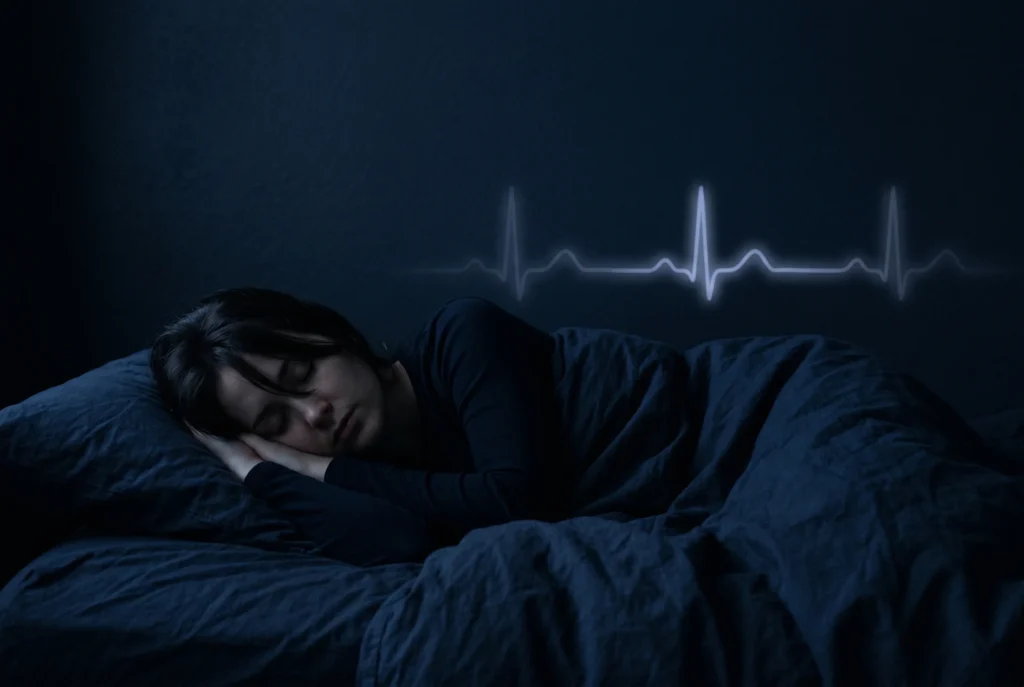


You know the feeling: evening in bed, quickly checking the news, watching an episode of a show, scrolling through Instagram. And then you lie awake. That’s no coincidence. The blue light from your screens suppresses melatonin production, more than most people think. A study by Chang and colleagues (2015) found that reading on an iPad before bed reduced melatonin secretion by 55 percent and delayed sleep by an average of 10 minutes. But the effect goes beyond melatonin. Here’s the explanation and what you can do.
How blue light destroys sleep
Light is the strongest signal for the circadian rhythm. The eye contains special receptors, intrinsically photosensitive retinal ganglion cells, that are particularly sensitive to short-wavelength light in the range of 460 to 480 nanometers. LED screens emit exactly in this range. When you look at your phone in the evening, these receptors signal to your brain: it’s daytime. The suprachiasmatic nucleus, the biological clock in the hypothalamus, then stops melatonin release. Melatonin is the hormone that prepares the body for sleep. Without melatonin, falling asleep is harder, sleep becomes shallower, and total sleep duration shortens. A study by Wood and colleagues (2019) found that just 2 hours of screen use in the evening significantly reduced melatonin production, regardless of screen brightness.
Not just phones: All screens are affected
The problem isn’t limited to smartphones. Tablets, laptops, TVs, e-readers with backlit displays: they all emit blue light. A study by Heath and colleagues (2014) found that melatonin suppression from tablets and laptops was even stronger than from smartphones because the larger screens project more light onto the retina. E-readers with E-Ink displays like the basic Kindle Paperwhite are the only exception because they use reflected light rather than emitted light. If you read in the evening, switch to E-Ink or a printed book. All other screens, even with night mode or blue light filters, still emit enough light to affect the circadian rhythm.
Night mode isn’t enough
Many people believe that night mode on their phone solves the problem. It doesn’t. Night mode reduces the blue light component and warms the color temperature, but it doesn’t eliminate blue light entirely. A study by Ayaki and colleagues (2019) found that night mode only reduced melatonin suppression by about 30 to 50 percent. This means: even with night mode activated, a significant amount of blue light is still emitted. Moreover, light isn’t the only problem. Cognitive stimulation is also an issue. Social media, news, and shows activate the brain, raise cortisol levels, and make it harder to wind down. The best filter is useless if you’re emotionally agitated.
The time before bed: What really helps
The most effective measure is the simplest: no screens in the last hour before bedtime. One hour is enough to get melatonin production going again. If that’s not possible, at least 30 minutes of screen-free time. What instead? Reading a printed book, taking a warm bath, light stretching, talking with your partner, journaling. All of these activities are cognitively low-demand and promote relaxation. A study by Hauri and colleagues (2018) found that a one-hour screen break before bed shortened sleep onset by an average of 17 minutes and improved sleep efficiency by 6 percent.
Light management: Daytime and evening
It’s not just about reducing blue light in the evening, but also about getting the right light during the day. Bright daylight in the morning stabilizes the circadian rhythm and makes the body less sensitive to evening light. People who get 30 minutes of daylight in the morning have a more robust melatonin rhythm in the evening. The strategy is twofold: lots of bright light during the day, little or no blue light in the evening. Paying attention to both yields a significantly more stable sleep-wake rhythm than just avoiding screens at night while sitting in the dark during the day.
Blue light blocking glasses: Are they useful?
Blue light blocking glasses block short-wavelength light in the 460 to 480 nanometer range while allowing longer-wavelength light through. The evidence is mixed. A meta-analysis by Law and colleagues (2022) found a small but significant effect on sleep onset latency and sleep quality in people who wore the glasses 2 to 3 hours before bedtime. But the effect was smaller than complete screen avoidance. The glasses are a good stopgap for people who have to work in the evening or rely on screens for other reasons. They are not a substitute for screen avoidance.
Conclusion: Your evening belongs to you, not your screen
Blue light from screens suppresses melatonin production, delays sleep, and reduces sleep quality. Night mode reduces the problem but doesn’t solve it. The most effective measure is one hour without screens before bedtime. If you must work, use blue light blocking glasses, but know they’re only a stopgap. Daytime light management is just as important: bright daylight in the morning makes the circadian rhythm more robust. If you want to reclaim your evening, start with a simple rule: one hour before bed, no screens. That’s the beginning.
Beste Grüße, Kai
Haupt-Keyword: blue light sleep
Sekundäre Keywords: screen sleep, blue light blocking glasses, melatonin screen, phone before bed, blue light night mode